
Scope 1, 2 and 3 are the three categories used by the Greenhouse Gas Protocol to organise a company’s greenhouse gas emissions. Scope 1 covers direct emissions from sources the company owns or controls. Scope 2 covers emissions from generating the electricity, steam, heat and cooling the company buys and uses. Scope 3 covers the other indirect emissions associated with the company’s value chain, both upstream and downstream.
While those definitions are fairly easy to understand, there is nuance in understanding how real-world activities map into each scope. A petrol van may be Scope 1 if the company operates it, while the same delivery made by a courier is Scope 3. Electricity used to charge a company electric vehicle will normally sit in Scope 2, even though the journey itself may look much the same as one made in the petrol van.
For that reason, it helps to think about the relationship the business has with the source of the emissions. Ownership and control matter for Scope 1. Purchased energy matters for Scope 2. Once neither of those applies, the activity will often sit somewhere in Scope 3, where the particular relationship in the value chain determines the category.
Scope 1, 2 and 3 emissions at a glance
| Scope | What it covers | Typical business examples |
|---|---|---|
| Scope 1 emissions | Direct emissions from sources the organisation owns or controls | Gas boilers, company-operated petrol or diesel vehicles, fuel burned in machinery, process emissions, refrigerant leakage |
| Scope 2 emissions | Indirect emissions from purchased or acquired electricity, steam, heat and cooling | Electricity used in offices, factories and warehouses; purchased district heating or cooling |
| Scope 3 emissions | Other indirect emissions across the value chain | Purchased goods, freight, waste, business travel, commuting, leased assets, use of sold products, investments |
Within one company’s greenhouse-gas inventory, the three scopes are kept separate. If an emission is already being accounted for in Scope 1 or Scope 2, the company does not put that same emission into its Scope 3 as well.
That does not mean the same physical emission appears only once across the whole economy. An airline records the fuel it burns as its Scope 1 emissions, while a company whose employee takes the flight records its share of that journey in Scope 3 business travel. In the same way, a supplier’s Scope 1 emissions can form part of a customer’s Scope 3 footprint. The inventories are answering different questions about the same value chain.
All of that is easier to hold in mind as one picture. Draw a line around the organisation you are reporting on, and the three scopes arrange themselves around it.
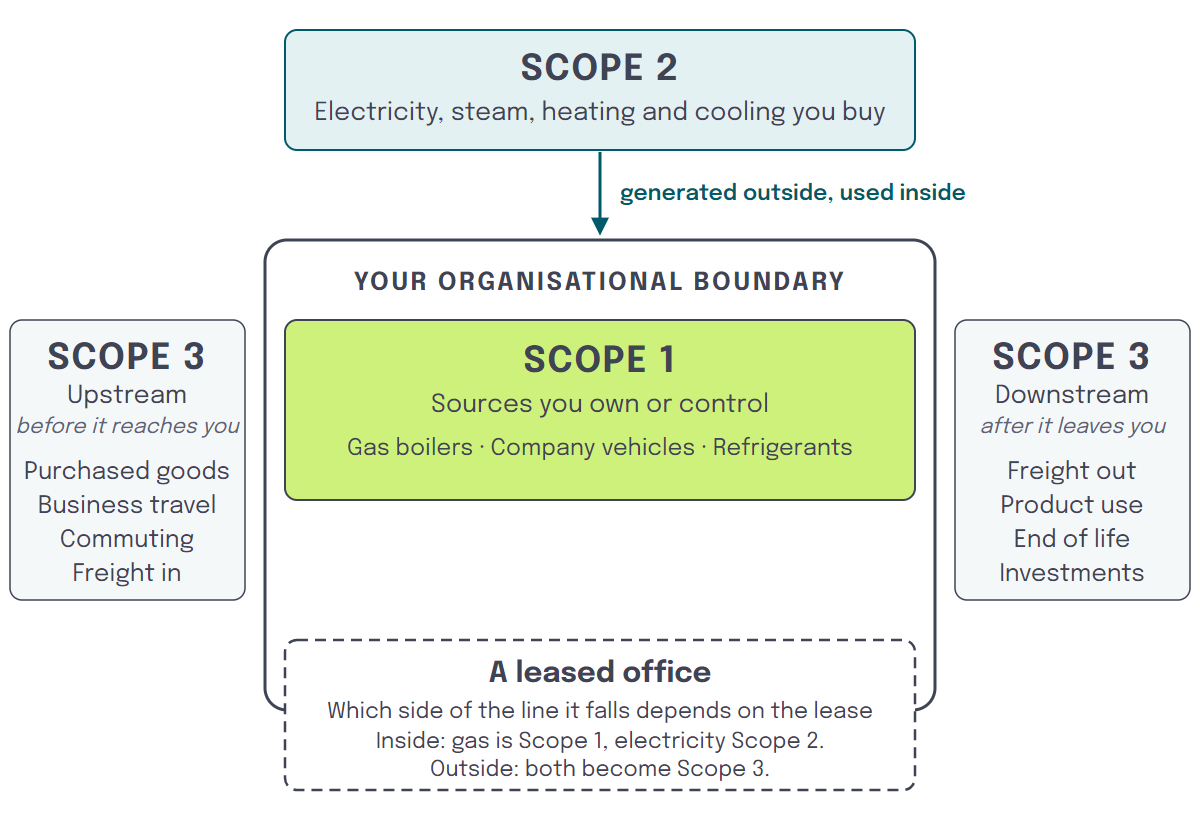
Reading it from the middle out: emissions from sources inside the line are Scope 1, whether that is a boiler you run, a van you operate or a refrigerant that leaks. The electricity, heat, steam and cooling you buy are generated outside the line and consumed inside it, so they cross it, and that is Scope 2. Everything else in the value chain sits outside the line altogether, upstream on the way in and downstream on the way out, and that is Scope 3.
The dashed box at the bottom is the part worth pausing on. A leased office can fall on either side of the line, depending on the lease and on the consolidation approach the company has chosen. Inside the line, its gas is Scope 1 and its electricity Scope 2. Outside it, both become Scope 3. The building has not changed and neither have the tonnes; only the position of the line has.
That is why the boundary has to be settled before anything is classified.
Scope 1 emissions come from sources the business owns or controls
Scope 1 emissions are the direct greenhouse-gas emissions from operations that fall within the company’s chosen organisational boundary. For many businesses, the most familiar examples are gas burned in a boiler, fuel used by company vehicles, fuel burned in generators or machinery, and refrigerant gases leaking from air-conditioning or refrigeration equipment.
It is tempting to reduce Scope 1 to “things we own”, but control is just as important. The GHG Protocol allows companies to consolidate their emissions using equity share, financial control or operational control, and the approach chosen can affect which assets and operations sit inside the footprint.
For a small company trading from one office, this distinction may not cause much difficulty. It becomes more important in a group with subsidiaries, joint ventures, leased sites, shared operations or vehicles that are not owned outright. Before trying to classify those emissions, the organisational boundary needs to be clear enough that the same logic can be applied consistently from one year to the next.
Scope 1 emissions examples
Common Scope 1 sources include:
- natural gas burned in a boiler the company operates;
- petrol or diesel used by company-controlled vehicles;
- LPG, heating oil or other fuels burned on site;
- fuel used in generators, plant or manufacturing equipment;
- process emissions from industrial activity;
- refrigerant leakage from equipment under the company’s control.
For an ordinary company fleet, the treatment is usually fairly straightforward. If the business operates a petrol or diesel van and the vehicle sits inside its organisational boundary, the fuel combustion is Scope 1.
An electric company vehicle works differently. There is no tailpipe combustion to record in Scope 1, while the electricity purchased to charge the vehicle will normally appear in Scope 2. There may also be upstream emissions associated with producing and delivering that energy in Scope 3 Category 3.
If the company stops using its own van and pays a third-party courier instead, the emissions have moved outside the company’s direct control and into Scope 3. The business activity is still a delivery, but the accounting treatment has changed because the source of the emissions has changed.
Scope 2 emissions cover purchased electricity, heat, steam and cooling
Scope 2 covers emissions from the generation of purchased or acquired electricity, steam, heat and cooling consumed by the reporting company. In practice, purchased electricity is the main Scope 2 source for many UK businesses.
The emissions physically occur at the power station rather than at the office, factory or warehouse using the electricity, which is why they are indirect rather than Scope 1. The GHG Protocol gives purchased energy its own scope because energy use is both significant and closely connected to the company’s operations.
When electricity data are available, the useful starting point is the amount consumed in kWh. The amount paid on the bill may be useful for finance, but it is a poor substitute for physical activity data because prices can move independently of consumption. A company can spend more while using less electricity, or spend less while using more.
Scope 2 location-based and market-based emissions
Scope 2 also has an accounting distinction that can be confusing when companies begin buying renewable electricity.
The location-based method reflects the average emissions intensity of the electricity grid where the company consumes power. The market-based method, where it applies, can reflect qualifying contractual arrangements such as electricity products or energy attribute instruments, provided the GHG Protocol’s quality criteria are met.
For companies operating in markets where the market-based method applies, the GHG Protocol requires both figures to be reported. This is why a statement such as “our electricity is renewable, so our Scope 2 emissions are zero” does not tell you enough on its own. The reader needs to know whether the company is referring to its market-based figure, what evidence supports that figure, and what the location-based result looks like alongside it.
The Scope 2 rules are currently under review. GHG Protocol completed a public consultation on revisions during 2025 and 2026, including proposals on hourly matching and deliverability, but the existing Scope 2 Guidance remains the relevant standard while that work continues.
Scope 3 emissions cover the wider value chain
Scope 3 includes the indirect emissions that are not already included in Scope 2 and that occur elsewhere in the reporting company’s value chain. This is the scope that tends to look very different from one organisation to another because it reflects what the business buys, how it operates, what it sells and, in some cases, what happens to those products long after they leave the company.
The GHG Protocol divides Scope 3 into 15 categories. They cover purchased goods and capital equipment, fuel- and energy-related activities, freight, waste, business travel, commuting, leased assets, downstream transport, product use, end-of-life treatment, franchises and investments.
There is no reason to expect all 15 categories to be equally significant. For an office-based consultancy, travel, commuting and purchased services may account for much of the wider footprint. For a manufacturer, purchased materials or the use of sold products may be far larger than the emissions from its offices. A financial institution can arrive at a completely different picture again once investment emissions are considered.
This is also why a partial Scope 3 calculation should be described as partial. A company may have an excellent figure for business travel and waste while still having little idea what its purchased goods contribute. That work is useful, but it does not become a complete value-chain footprint simply because the numbers that have been calculated are accurate.
The 15 Scope 3 emissions categories
The first eight Scope 3 categories are upstream, dealing broadly with activities associated with what the company buys and uses. Categories 9 to 15 are downstream and relate to goods, services, assets and investments after they leave or sit beyond the reporting company’s own operations.
| Scope 3 category | What it includes |
|---|---|
| 1. Purchased goods and services | Emissions from producing goods and services bought by the company |
| 2. Capital goods | Emissions from producing capital assets purchased by the company |
| 3. Fuel- and energy-related activities | Upstream emissions from fuels and energy not already included in Scope 1 or Scope 2 |
| 4. Upstream transportation and distribution | Third-party transport and distribution of purchased goods, plus transport and distribution services purchased by the reporting company |
| 5. Waste generated in operations | Treatment and disposal of waste produced by the company’s operations |
| 6. Business travel | Employee business travel in vehicles owned or operated by third parties |
| 7. Employee commuting | Travel between employees’ homes and workplaces; teleworking emissions may also be included |
| 8. Upstream leased assets | Operation of assets leased by the reporting company that are not already included in Scope 1 or Scope 2 |
| 9. Downstream transportation and distribution | Transport, storage and retail of sold products after the company’s operations where the reporting company has not purchased the transport service |
| 10. Processing of sold products | Processing of intermediate products sold by the reporting company |
| 11. Use of sold products | Emissions arising when customers use products sold by the company |
| 12. End-of-life treatment of sold products | Disposal and treatment of sold products at the end of their life |
| 13. Downstream leased assets | Operation of assets owned by the reporting company and leased to others, where not already included in Scope 1 or Scope 2 |
| 14. Franchises | Emissions from franchise operations not included in Scope 1 or Scope 2 |
| 15. Investments | Emissions associated with investments, according to the category requirements |
Business travel can be Scope 1 or Scope 3 emissions
Business travel is one of the easiest places to see why activity labels can be misleading.
Under the GHG Protocol, employee travel for business in vehicles owned or operated by third parties belongs in Scope 3 Category 6. Flights, rail journeys, taxis, coaches and rental cars will usually sit here, as will business mileage in employee-owned vehicles.
If the employee makes the journey in a petrol or diesel vehicle that is owned or controlled by the company, the fuel combustion is generally Scope 1 instead. The purpose of the journey has not changed; the company’s relationship to the source of the emissions has.
Ordinary travel between home and the usual workplace is treated separately as employee commuting in Scope 3 Category 7. That is worth keeping clear in both the data collection and the final report, particularly where mileage claims, taxis and staff surveys are being combined from different systems.
C Level’s flight carbon calculator calculates individual flight emissions, while the business carbon footprint calculator brings business travel together with other operational emissions sources.
Employee commuting and homeworking sit within Scope 3 emissions
Employee commuting is Scope 3 Category 7, covering journeys between employees’ homes and their workplaces in vehicles that are not owned or operated by the reporting company.
The GHG Protocol also allows companies to include teleworking emissions within Category 7. Where homeworking is calculated, the sensible boundary is the additional energy associated with working from home rather than the whole household energy bill.
For example, a refrigerator that would be running whether someone was at home or in the office is not an additional homeworking load. Heating a room for the working day may be. In practice, companies often have to estimate this category because they do not have metered data for employees’ homes, and there is nothing inherently wrong with an estimate provided the method and uncertainty are clear.
An estimate and a zero are not the same thing. Where the information is weak, it is better for the footprint to say so than to make an unmeasured source disappear.
Freight emissions can fall into Scope 1, Scope 3 Category 4 or Scope 3 Category 9
Freight causes confusion because the direction of travel is only part of the classification.
Where goods are moved in a vehicle owned or controlled by the reporting company, the direct fuel combustion is generally Scope 1.
Where a third-party carrier brings purchased products from a tier-one supplier to the company’s operations, the transport sits in Scope 3 Category 4. Category 4 also includes third-party transport services purchased by the reporting company, which can include outbound logistics for sold goods and transport between the company’s own sites.
Scope 3 Category 9 covers downstream transportation and distribution of sold products after the company’s operations where the reporting company has not purchased the transport service. It can also include downstream storage and retail.
This means that a rule such as “inbound is Category 4 and outbound is Category 9” will produce the wrong answer in some perfectly ordinary cases. If the company pays a haulier to deliver sold goods to its customer, that transport can remain in Category 4. If the customer arranges the delivery after the sale, it can fall into Category 9.
The tonnes of CO₂e may be identical either way, but the inventory is more useful when the category reflects what actually happened.
Leased assets can move between Scope 1, Scope 2 and Scope 3 emissions
Leased assets are another area where the organisational boundary matters more than the everyday description of the asset.
A building, vehicle or piece of equipment may be legally owned by somebody else but still fall within the reporting company’s Scope 1 or Scope 2 if the company has the relevant control under its chosen consolidation approach. Where a leased asset is not already included in Scope 1 or Scope 2, emissions from its operation may fall into Scope 3 Category 8 for upstream leased assets.
Assets owned by the reporting company and leased to other organisations can appear in Scope 3 Category 13 where they are not already captured in the reporting company’s Scope 1 or Scope 2.
For businesses with a substantial leased estate or vehicle fleet, this is a good place to document the accounting treatment rather than relying on assumptions made from the word “leased”.
Scope 1, 2 and 3 emissions cannot be compared between companies without context
A company reporting 900 tCO₂e does not necessarily have a smaller footprint than one reporting 2,000 tCO₂e.
The first company may have calculated only Scope 1 and Scope 2. The second may have included a material Scope 3 inventory covering purchased goods, freight, travel and product use. They may also be using different organisational boundaries, factor years or approaches to purchased electricity.
The GHG Protocol Scope 3 Standard is primarily designed to help a company understand and manage its own value-chain emissions over time. Company-to-company comparisons require much more consistency in boundaries, methods and data than a headline total can show.
When looking at a footprint, the boundary and the exclusions are therefore as important as the number. A smaller total can simply mean that less has been measured.
Scope 1, 2 and 3 emissions under UK reporting rules
The scope definitions themselves do not tell a UK company exactly what it is legally required to disclose. That depends on the reporting regime, and this is where the common shorthand that “Scope 1 and 2 are mandatory while Scope 3 is voluntary” becomes too broad.
Under SECR, quoted companies must report their relevant Scope 1 and Scope 2 emissions. Large unquoted companies and LLPs also have mandatory UK energy and emissions reporting, and their minimum requirements include a limited Scope 3 element: business travel in rental cars or employee-owned vehicles where the company is responsible for purchasing the fuel. Other Scope 3 emissions are voluntary under the minimum SECR rules, although wider reporting may be appropriate where they are material or required for another purpose.
Relevant central-government procurements under PPN 006 use a different boundary again. Carbon Reduction Plans must include Scope 1 and Scope 2, together with five Scope 3 categories: upstream transportation and distribution, waste generated in operations, business travel, employee commuting and downstream transportation and distribution.
A company preparing an inventory for a science-based target, customer request, investor disclosure or another reporting framework may need to go wider still. So, before deciding how much Scope 3 work is required, it is worth being clear about what the footprint is being prepared for. If the answer is a science-based target, carbon credits sit outside that target’s progress: see our guide to SBTi targets and carbon credits.
For the detail on UK company reporting, see our SECR reporting guide and Carbon Reduction Plan guide.
Calculating Scope 1, 2 and 3 emissions starts with activity data
Most emissions calculations reduce to a fairly simple equation:
Activity data × emission factor = greenhouse gas emissions
A gas bill gives you kWh. Fuel records give you litres. A mileage record gives you distance. The relevant emission factor converts that activity into kg or tonnes of CO₂e.
For UK business reporting, the Government publishes annual greenhouse-gas conversion factors covering fuels, electricity, transport, waste, water and many other activities.
The calculation is only as good as the activity data and the boundary behind it, though. A company can multiply every figure correctly and still produce a misleading footprint because one site was left out, a reporting period is incomplete or a large Scope 3 source was never assessed.
This is particularly noticeable in Scope 3, where an apparently precise number may rest on broad spend estimates while another category remains unquantified. A sensible report makes that difference visible rather than presenting every tonne as if it has the same level of certainty.
For a fuller guide to boundaries, activity data and emission factors, see how to calculate a business carbon footprint.
C Level’s business calculator covers Scope 1, Scope 2 and selected Scope 3 emissions
C Level’s Business Carbon Footprint Calculator is intended to give a business a useful operational footprint without pretending that a short online questionnaire can reconstruct every part of a complex value chain.
It covers Scope 1, Scope 2 and common operational Scope 3 sources, with additional questions for travel and freight. The report shows the sources included in the calculation so that the reader can see what the total represents.
For many office-based or service businesses, this can provide a useful first view of the emissions from energy, fuel, vehicles, travel, commuting, waste and other common activities. A manufacturer with large purchased-material emissions, a business whose sold products consume substantial energy, or a financial institution with material investment emissions will need to go further if it wants a materially complete Scope 3 inventory.
That does not make the calculator result less useful. It simply means the boundary needs to travel with the number. A 40-tonne operational footprint and a 40-tonne complete value-chain footprint are not the same thing.
Calculate your business carbon footprint
Scope 1, 2 and 3 emissions lead to different reduction decisions
Once the scopes have been classified properly, they begin to show where the company has different kinds of influence.
Scope 1 emissions often lead directly into operational decisions: changing a fuel, replacing a boiler, electrifying vehicles, improving process efficiency or reducing refrigerant leakage.
Scope 2 connects the footprint to how much energy the company consumes and, where appropriate, how that electricity is purchased.
Scope 3 takes the work into the wider business: purchasing, freight contracts, travel policy, supplier engagement, product design, customer use, waste and investment decisions.
The largest opportunity will not necessarily sit in the scope that is easiest to measure or the scope the company controls most directly. An office electricity figure may be highly accurate and still be relatively unimportant beside the emissions from materials in a manufacturing business. In that situation, improving the office calculation from good to perfect will do less for the carbon strategy than getting a reasonable understanding of the supply chain.
A useful inventory therefore does more than divide emissions into three columns. It gives the business enough information to decide where better data and actual reductions are worth the effort.
Scope 1, 2 and 3 emissions FAQs
Yes. The GHG Protocol uses Scope 1, Scope 2 and Scope 3 to describe a company’s direct and indirect greenhouse-gas emissions across its operations and value chain.
A particular statutory disclosure, calculator or project may use a narrower boundary, so the published total should always make clear which scopes and categories it includes.
Scope 1 is direct emissions from sources the organisation owns or controls. Scope 2 is emissions from generating the electricity, steam, heat and cooling the organisation buys and consumes. Scope 3 is the other indirect emissions that occur across its value chain.
A petrol or diesel vehicle owned or controlled by the company will normally create Scope 1 emissions from the fuel it burns. Business travel in third-party vehicles is generally Scope 3, while leased vehicles can require closer examination of the organisational boundary.
Business travel in transport owned or operated by third parties belongs in Scope 3 Category 6. Travel in a company-controlled combustion vehicle will generally create Scope 1 emissions instead, while ordinary commuting between home and work belongs in Scope 3 Category 7.
Purchased electricity consumed by the reporting organisation is Scope 2. Where the market-based method applies, companies report both location-based and market-based Scope 2 figures.
It can be. The GHG Protocol allows additional teleworking emissions to be included within Scope 3 Category 7 alongside employee commuting.
Third-party freight will usually be Scope 3, although the category depends on the commercial relationship. Transport services purchased by the reporting company and transport of purchased goods from tier-one suppliers fall within Category 4. Downstream transport of sold products arranged by the customer or another downstream party can fall within Category 9. Freight in a company-controlled combustion vehicle will normally create Scope 1 emissions instead.
Yes. Purchased goods and services, capital goods, upstream freight and several other Scope 3 categories include emissions that occur in the supply chain.
Some are. For large unquoted companies and LLPs, the minimum SECR requirements include business travel in rental cars or employee-owned vehicles where the company is responsible for purchasing the fuel. Other Scope 3 categories are outside the minimum requirement, although wider reporting may be relevant or required elsewhere. Quoted companies have a different SECR reporting boundary.
No. Carbon credits or project-based climate action should be reported separately from the company’s gross Scope 1, Scope 2 and Scope 3 inventory. Funding 500 tonnes of climate action does not turn a 500 tCO₂e gross corporate footprint into zero.
Yes. On 29 July 2026, GHG Protocol announced that it and ISO will develop a single harmonised corporate carbon-accounting standard bringing together the Corporate Standard, Scope 2 Guidance, Scope 3 Standard, the Actions and Market Instruments work and ISO 14064-1.
The current standards remain in use while that development work continues.
Calculate Scope 1, 2 and common Scope 3 emissions
If you have your energy, fuel, vehicle and travel information to hand, C Level’s free Business Carbon Footprint Calculator can give you a first operational footprint using the current UK Government company-reporting conversion factors.
For a company with a substantial supply chain, complex organisational boundary or material Scope 3 categories outside the calculator, a fuller inventory will require more work. Our carbon footprint consultancy covers those cases.
Talk to us about a fuller footprint
Sources and methodology for Scope 1, 2 and 3 emissions
This article was reviewed against primary sources on 9 September 2026. Nothing here is legal, audit or tax advice.
- Greenhouse Gas Protocol, Corporate Accounting and Reporting Standard. Source for the definitions of direct and indirect emissions, the three scopes, and the equity-share, financial-control and operational-control approaches to the organisational boundary. View the standard.
- Greenhouse Gas Protocol, Calculation Tools FAQ. Source for the rule that emissions from leased facilities and vehicles may be Scope 1, Scope 2 or Scope 3 depending on the source, the boundary approach and the leasing arrangement. View the answers.
- Greenhouse Gas Protocol, Scope 2 Guidance. Source for purchased energy, location-based and market-based accounting, the quality criteria attached to contractual instruments, and the requirement to report both figures. View the guidance.
- Greenhouse Gas Protocol, Corporate Value Chain (Scope 3) Standard and Scope 3 Calculation Guidance. Source for the 15 Scope 3 categories, the upstream and downstream boundary, and the treatment of purchased transport services in Category 4. View the calculation guidance.
- Greenhouse Gas Protocol, public consultations. Source for the Scope 2 revisions consultation opened in October 2025, including the hourly matching and deliverability proposals. View the consultations.
- Greenhouse Gas Protocol, standard development update, 29 July 2026. Source for the single harmonised corporate standard bringing together the Corporate Standard, Scope 2 Guidance, Scope 3 Standard, the Actions and Market Instruments work and ISO 14064-1. View the announcement.
- HM Government, Environmental Reporting Guidelines, including SECR requirements. Source for the different minimum requirements for quoted companies and for large unquoted companies and LLPs, including the mandatory business-travel element. View the guidelines.
- Cabinet Office, PPN 006: taking account of Carbon Reduction Plans in the procurement of major government contracts. Source for the five Scope 3 categories a Carbon Reduction Plan must cover. View the policy note.
- Department for Energy Security and Net Zero, UK Government greenhouse gas conversion factors 2026. Source for the current UK company-reporting factors covering fuels, electricity, transport, waste and water. View the factors.