Ecotrust in action in Africa’s Great Rift Valley
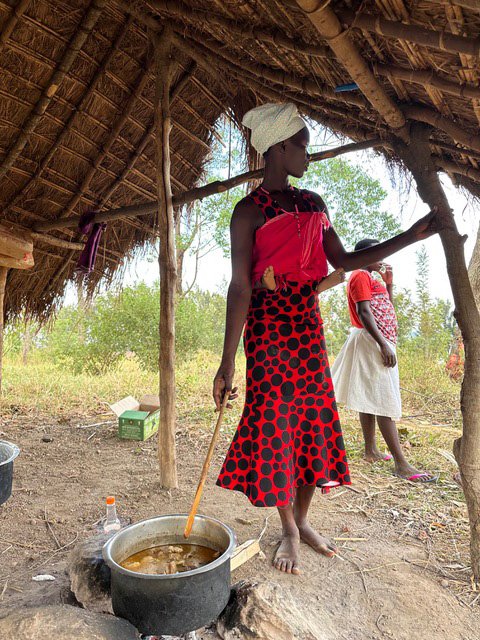
People here can build their new home in a day. They build from the earth under their feet and the wood on their land.
More than anything there is a sense of the people and the land being intertwined, inseparable.
I have been taking a deep dive into the Impact of nature regeneration projects we support in Uganda.
We have worked with our local partner Ecotrust for many years, and during that time they have dramatically scaled what they do with local communities in removing carbon and restoring nature. Over the last year they worked with some 40,000 people across Uganda.
Throughout February we are helping create a series of films with Ecotrust and the film crew we partner with.
We are seeing the way Ecotrust staff are able to work successfully at the grass roots level. Working with rural communities of small holder farms on long term regeneration projects is not easy.
Few organisations can deal with the diversity and dynamics of hundreds of community groups. It takes a lot of passion, patience and flexibility from the team.
And with that the innovation and dynamism can be nurtured into action. Giving agency to people in their own place, on their own land. Intertwining cultural and ecological regeneration across whole landscapes.
Working at the grass roots, their flagship Trees for Global Benefits project planted some 2 million trees in wood lots, in agroforestry or on the boundaries of the famers small plots of land (2023).
Ecotrust has been around for 25 years. They do not stand still. They are orchestrating multiple partners, and the same rural communities, on a new kind of regenerative project, focussing on restoring nature and biodiversity. Carbon removal is still in the mix but they are dialling up on biodiversity, making that the focus. To do this they are focussed not on the family farms, but on the all important communal forests.
Here are two stories we have witnessed and filmed that speak to these new Biodiversity projects:
Budongo to Bugoma Forest – Visionary large scale Regeneration Project focused on livelihoods built on nature regeneration
Working with rural communities, many of whom are already planting trees on their own land, the big vision is to regenerate and protect biodiversity across a large area, the Murchison Biodiversity project in the Northern Albertine Rift Valley, North West Uganda. The aim is to protect and restore over 50,000 hectares of indigenous forest.
This area has two large pristine tropical high forests called Budongo and Bugoma and until the last few decades, these where ecologically connected through nature corridors formed from smaller protected forests.
Right now the nature corridors between the high forests have been settled and the forests cut down or degraded for small holder cultivation, plantations of exotic tree species, and other large scale plantations like tea.
This decline is detrimental for human grass roots livelihoods and for the ecosystem, including the flagship endangered mammal, the Eastern Chimpanzee (estimated at 5000 individuals surviving in this part of Africa).
The solution Ecotrust is working with is to recreate the ecological connections between the two large fragments of tropical forest. They are doing this by protecting and restoring patches of forest in the 40km corridor between the Budongo and Bugoma Forests.
With all the forests and communities we are visiting, it’s striking how dependent people are on the land and nature for their needs. From food to building their homes, it all comes from the land and the forests.
Ecotrust is active in restoring this Bugoma to Budongo land scape corridor in a total of 6 areas.
Here are two stories we have witnessed and filmed that speak to the regeneration of livelihoods and nature in two of these areas in the landscape corridor:
Ongo Forest
Through Ecotrust’s orchestration and hard work, some 300 households now have control of the Ongo Communal Forest for the first time.
They have been granted legal tenure to protect and manage the forest of some 180 hectares. The forest is degraded from years of a free for all situation where people would come in and take whatever they could. Timber, charcoal making, clearing and farming, all degrading the forest and bringing down the rich biodiversity.
Now, the Communal Forest is controlled by the community through the creation of a Community Land Association (CLA). This innovation provides for formal, legal control of the forest by the community.
The next step is ongoing and is where Ecotrust orchestrate’s new sustainable livelihoods. This stage is focussed on creating micro businesses in Bee keeping and Ecotourism.
Alimugonza Forest
Again, with Ecotrust orchestration, they have secured their community forest (44 hectares), using the concept of the Community Land Association. Now they can manage the forest instead of raiding it. It changes the game from extraction to giving back to the forest.
To look after the forest, money is needed. Micro businesses are needed, connected to the forest and relying on the regenerating forest.
They have set up the Alimugonza Beekeeping Centre of Excellence, to help more start up bee keeping and grow the existing micro businesses.
Partnerships with established honey enterprises in Kenya are helping grow the businesses and the value chain.
Further scaling can happen using the cooperative model.
The vision for nature regeneration that intertwines ecology and culture is big with the Murchison Project. New livelihoods that are built on nature regeneration. People and nature creating new value together.
C Level has only ever and will only ever work with truly Regenerative Projects – ones that remove carbon, restore nature, rebuild community and return inspiration to everyone with a stake in the project.
Ecotrust’s Trees for Global Benefits is doing just this. Their new Murchison Biodiversity project is aiming to create new Nature Finance to empower communities to restore and protect communal forests and reconnect the remaining high tropical forests of Bugoma to Budongo.
Ecotrust and the communities go from strength to strength. Decades of work (funded way back in the day by USAID) has created a scaled up way for achieving intertwined nature and community regeneration.
Plan Vivo carbon removal certificates are available now. Plan Vivo biodiversity certificates are being developed – both are the mechanism to align corporate goals and finance flows with the combined power of people and nature – intertwined nature and community regeneration.